That grinding sound when you brake isn’t just annoying. It’s your vehicle telling you something is wrong, and in Calgary’s stop-and-go traffic, ignoring it costs more than a repair bill.
Most drivers in Calgary who show up with squeaky or pulsating brakes have already waited too long. By the time those warning signs kick in, the damage is often already done.
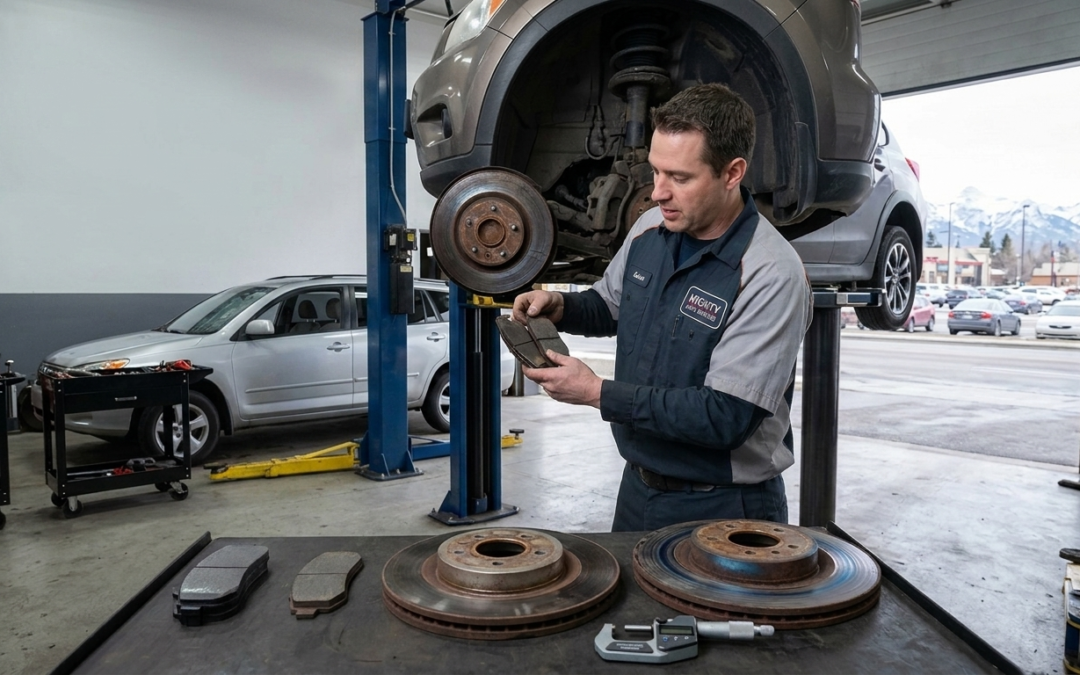
Here’s the thing: brake pads start out somewhere between 10 and 12 millimeters thick. Once they wear down to 3 mm or less, you’re in dangerous territory. Metal starts grinding against metal, and your rotors take the hit. At that point, you’re no longer just replacing pads.
A simple $150 new brake pads Calgary service can easily turn into an axle job costing well over $500 if you wait even a week too long. Timing is everything with your brakes. Catching the wear early means a quick, affordable fix—waiting too long means a massive brake repair Calgary bill.
The most common mistake: assuming squealing brakes always mean new pads. Sometimes the rotors are the real problem, and replacing pads on scored or warped rotors is money wasted.
This blog explains the exact signs that separate a pad replacement from a full rotor service. By the end, you’ll know what your brakes need before you book an appointment.
Not sure what your brakes need? Mighty Auto Repairs offers honest brake inspections in Calgary. Book yours today at mightyautorepairs.ca
Warning Signs Your Brake Pads Need Replacing in Calgary
Brake pads worn to 3 mm or below require immediate replacement — at that thickness, the metal backing plate contacts the rotor directly, causing rapid damage to both components. (Crossdrilledrotors.ca, 2025.)
Frequent braking on routes such as Deerfoot Trail, the Crowchild–Stoney interchange, and in school zones places significant stress on brake pads in Calgary driving conditions. City drivers frequently experience pad wear 30–40% more quickly than commuters on the highway. Repeated heat spikes from stop-and-go cycles hasten the breakdown of friction materials. Watch for the following warning signs:
- Squealing or high-pitched squeaking: A built-in wear indicator — a small metal tab — contacts the rotor when pads drop to roughly 2–3 mm. That squeal is intentional. It’s a warning.
- Grinding or growling: Metal-on-metal contact. The pad friction material is gone. Stop driving and book a same-day inspection.
Longer stopping distances: If your vehicle takes noticeably more road to stop, pad thickness is likely below the safe threshold.
- Brake pedal feels soft or spongy: Can indicate pad wear, but also points to brake fluid issues or air in the lines. A full system check is needed.
- Vehicle pulls to one side when braking: Uneven pad wear between the left and right sides. One pad is more worn than the other.
A 2025 peer-reviewed study on brake pad wear modeling (Jensen & Santos, Wear, 2025) confirmed that urban stop-and-go driving is the single largest variable in pad lifespan — far outweighing vehicle weight or pad material type.
If your brakes show two or more of these symptoms, schedule an inspection immediately rather than waiting for your next service interval. The wear indicators themselves are corroded by road salt and freeze-thaw cycles during Calgary’s winters, which can silence the squeal even as the pads continue to deteriorate.
How to Tell If Your Rotors Need Resurfacing or Full Replacement
Rotors must stay above their stamped minimum thickness — marked “MIN THK” on the rotor edge — or they cannot be legally or safely resurfaced. Below that threshold, only replacement is permitted. (Brembo Parts, 2025.)
Most online guides omit this information: resurfacing isn’t always an option. Because thinner metal cannot safely absorb and disperse braking heat, every rotor has a minimum thickness specified by the manufacturer. Rotors below their MIN THK specification are more susceptible to warping, cracking, and potential failure during emergency braking. (December 2025 Engineer Fix).
Signs your rotors need attention — not just your pads:
- Steering wheel or brake pedal vibration: Classic symptom of a warped rotor. The uneven surface causes the caliper to pulse as it grips.
- Visible grooves or scoring on the rotor face: Light scoring can sometimes be resurfaced. Deep grooves (typically over 1.5 mm) require full replacement.
- Blue discoloration on the rotor surface: Hot spots are areas where the metal gets so hot that it permanently warps or weakens. Once that happens, resurfacing won’t fix it. (Engineer Fix, December 2025.)
- Rotor edge lip over 1 mm: A raised lip around the rotor’s outer edge means the braking surface has worn significantly below the edge. Replacement is typically required.
- Rust pitting from winter storage or long disuse: Surface rust that doesn’t clear after a few stops is a sign of deeper corrosion. Common in Calgary vehicles parked through extended cold snaps.
Important Safety Note: Even if only one side looks bad, rotors on the same axle should always be replaced in pairs. If you try to save a buck by replacing just one side during a brake pad change service, the mismatched thickness will cause your vehicle to pull hard toward the thicker side when you hit the pedal.
For a safe, predictable stop on unpredictable local roads, a proper brake repair Calgary job means treating the left and right sides as a team. (Brembo Parts, 2025)
Resurfacing vs. Replacement: The Real Difference for Calgary Drivers
Rotor resurfacing costs less upfront but is only viable when the rotor remains above minimum thickness after machining — a condition many modern, thinner rotors cannot meet.
Here’s the honest trade-off most shops don’t spell out clearly:
| Resurfacing (Machining) | Full Replacement |
| Lower upfront cost | Higher upfront cost |
| Only for rotors above MIN THK spec | Required below MIN THK or with hot spots |
| Reduces rotor mass and heat capacity | Restores full heat absorption capacity |
| May not eliminate deep grooves | Eliminates all surface defects |
| Shorter service life after machining | Full manufacturer-rated lifespan |
| Not always possible on modern thin rotors | Always an option regardless of condition |
Across Canada, brake pad replacement typically costs between $150 and $300 per axle.
Depending on the type of vehicle and whether resurfacing or replacement is required, adding rotor work can cost anywhere from $300 to $800 per axle. (TIRECRAFT Canada, 2022; Crossdrilledrotors.ca, 2025.)
What to Budget for Brake Service in Calgary
Most local shops charge between $150 and $300 per axle for a standard brake pad replacement service. However, if your rotors are warped or worn down and you need both pads and a fresh set of rotors, you should budget between $250 and $500 per axle.
Combined jobs cost more simply because quality replacement parts are pricier and the precision labor takes a bit longer than a basic pad swap.
A Quick Insider Insight on “Squeaky Brakes”
An important industry trend worth noting is that: a huge number of vehicles that come in looking for a quick squeaky brakes fix actually have rotors that are too far gone to save.
Modern rotors are manufactured significantly thinner than older cars used to have, which means there is very little metal left for a traditional rotor resurfacing Calgary service. More often than not, trying to machine them pushes the metal right past its safe limit. Skipping the quick fix and going with a full replacement during your brake pad replacement service is almost always safer, lasts longer, and saves you money in the long run. (NRS Brakes, 2025)
If you’re unsure whether your rotors can be resurfaced or need full replacement, Mighty Auto Repairs offers transparent brake diagnostics in Calgary. No upselling — just an honest assessment.
Brake Pad Types: Which One Is Right for Your Calgary Vehicle?
Ceramic brake pads outlast organic pads by a significant margin and produce less dust — but they cost more upfront. The right choice depends on your vehicle type and driving pattern.
Three pad types dominate the Calgary aftermarket market:
- Organic (NAO) pads: Rotor-friendly and quieter. Wear more quickly; usually, 25,000 and 35,000 kilometers. Ideal for light city driving.
- Semi-metallic pads: Better heat dissipation. Suited for trucks, SUVs, and heavier stop-and-go use. Louder. More rotor wear.
- Ceramic pads: Quietest, longest lifespan (often 50,000–70,000 km in mixed driving), least rotor wear. Higher upfront cost. Best for most Calgary passenger vehicles.
Your pad compound directly determines how quickly your rotors and pads deteriorate, according to a 2025 brake wear study. When compared to harsher semi-metallic compounds, ceramic compounds significantly reduce rotor wear in heavy stop-and-go traffic.
For Calgary drivers commuting daily on high-traffic routes like 16 Ave NW, Macleod Trail, or the Deerfoot, premium ceramic pads are a much better investment. They offer a lasting squeaky brakes fix and hold up significantly better against the brutal mix of winter road salt and grit that quickly eats away at organic pads. Investing in quality ceramics during your next brake pad replacement service saves your rotors and lowers your long-term brake repair Calgary costs.
How Calgary’s Winters Affect Brake Wear — and What to Do About It
In addition to corroding brake hardware and accelerating rotor surface rust, road salt and freeze-thaw cycles can also silence wear indicators, leading to a false sense of security when pads are actually past their service limit.
This is the Alberta-specific reality that national brake guides miss entirely. Calgary winters bring:
- Road salt (sodium chloride) applied by the City of Calgary: Accelerates surface oxidation on rotor faces. Heavy surface rust after a cold snap can reduce effective braking on the first stop.
- Freeze-thaw corrosion on caliper slides and hardware: Seized caliper slides cause one pad to contact the rotor unevenly — wearing one side far faster than the other. This is often misdiagnosed as a pad issue when the caliper is the real problem.
- Moisture infiltration in brake fluid: The
- Silenced wear indicators: Metal wear tabs can corrode and break off during Calgary winters, removing the audible warning system entirely.
To reduce moisture contamination and prevent brake fluid boiling under extreme temperature conditions, most manufacturers recommend replacing brake fluid every two years.
The best method to prevent a brake failure during a Calgary cold snap is to do a pre-winter brake inspection, preferably in September or October before temperatures consistently fall below −0°C. Many repair shops experience significant scheduling backlogs by December.
What a Proper Brake Inspection in Calgary Should Include
A brake inspection that only measures pad thickness is incomplete — a thorough check covers seven components, and skipping any of them risks missing the actual cause of the problem.
- When you take your car to a Calgary shop for brake work, a qualified technician should inspect:
- Brake pad thickness on all four corners (measured in mm, not estimated visually)
- Rotor thickness at multiple points using a micrometer — compared against MIN THK spec stamped on the rotor
- Your rotors take a massive beating on local roads. Severe scoring, heat spots, and rotor warping cause brake pedal pulsation commonly during braking. If there is enough metal left, a professional rotor resurfacing Calgary service can smooth them out; otherwise, replacement is your safest bet.
- For your vehicle to stop safely, the calipers have to move completely freely. When winter road salt causes the slider pins or pistons to seize up, it leads to uneven braking and rapid wear. Catching this early during a standard brake pad replacement Calgary service prevents a much bigger repair bill later on.
- Never reuse old mounting accessories. Worn-out anti-rattle clips and insulating shims are almost always the true culprits behind a loud, frustrating squeal right after a fresh installation. Getting a proper, permanent squeaky brakes fix means replacing this hardware rather than just slapping on new pads.
- Check the state of your brake fluid and how much moisture it contains, either with a test strip or a refractometer.
- Brake hoses: inspect for cracking, swelling, or soft spots — especially on vehicles over eight years old
Red Flag:
Be cautious if a mechanic offers you a fast quote for a new brake pad replacement Calgary service but completely ignores your rotors. Every professional brake repair Calgary assessment should automatically include a thorough rotor inspection—and deciding whether you need a replacement or a precision rotor resurfacing Calgary service should never be a careless afterthought.
At Mighty Auto Repairs, every brake inspection includes all seven checks above before any work is recommended. A written estimate is provided before anything is touched.
The Bottom Line on Brake Repair in Calgary
When your brake pads drop below 3 mm, or your rotors wear too thin, it’s no longer just a minor maintenance issue—it’s a major safety hazard. Calgary’s brutal winters only speed up the damage, as harsh road salt aggressively corrodes vital hardware and constant freeze-thaw cycles can completely seize your calipers. Catching these warning signs early is always your safest and cheapest option.
The truth is, the daily stop-and-go grind on local roads is the single biggest cause of accelerated brake wear. If you’re already dealing with annoying squealing, grinding, or steering wheel vibrations, it’s time to book a professional brake repair Calgary service. Don’t wait for the next sudden cold snap to turn a simple, affordable fix into a massive repair bill.
Whether you need a straightforward new brake pad solution or a precision rotor resurfacing Calgary service, don’t wait for your brakes to completely fail.
Book at Mighty Auto Repairs
Get a permanent squeaky brakes fix and stay safe on winter roads. Book a reliable brake inspection at Mighty Auto Repairs in Calgary. You’ll get an honest assessment and a clear, written estimate before any work begins—completely pressure-free. Call today or visit mightyautorepairs.ca to schedule your appointment.
Frequently Asked Questions: Brake Repair Calgary
Q: How often should I need a brake pad replacement in Calgary?
A: Most brake pads last between 25,000 and 70,000 kilometers. However, if you are constantly dealing with stop-and-go commuter traffic downtown or on Deerfoot, expect to need new brake pads Calgary mechanic services closer to that lower 25,000 km limit.
- Pad Choice: Ceramic pads hold up much better to urban driving than organic ones.
- Maintenance Interval: Have your brakes inspected every 20,000 km—or roughly every second oil change—to catch wear early.
Q: Can my rotors be resurfaced, or do I need a brand-new set?
A: It depends on how much metal is left. A professional rotor resurfacing Calgary service is only an option if the rotor stays thicker than its safe limit, which is stamped right on the part as MIN THK.
Many modern rotors are built thin right out of the factory and cannot safely be machined. If your rotors have deep grooves, hard “hot spots,” or are already worn down, replacing them is the only safe choice.
Q: Why are my brakes squeaking right after getting new pads?
A: New brake pads often require a short bedding-in period. New pads require a “bedding-in” period of about 300 to 500 km to evenly transfer material onto the rotor surface.
If you are looking for a permanent squeaky brakes fix, and the noise doesn’t stop after 500 km, it usually means the new pads aren’t mating well with old rotors, anti-rattle hardware was left out, or the pads were installed onto uneven surfaces. (NRS Brakes)
Q: What does professional brake repair Calgary cost in 2026?
A: The following is what you can typically anticipate for standard passenger cars and SUVs in the Calgary area, depending on your particular vehicle type and what needs to be fixed.
| Service Type | Estimated Cost (Per Axle) |
| Brake Pads Only | $150 – $300 |
| Pads + Rotor Replacement/Resurfacing | $250 – $500 |
Note: If you drive a large truck, a heavy SUV, or a European import, your local brake repair Calgary costs will typically land at the higher end of these ranges. (Urban Lube Calgary; My Calgary Mechanic)
Q: Is it safe to drive with squeaky brakes?
Squeaking caused by the built-in wear indicator means pads are at approximately 2–3 mm — still marginally above the 3 mm replacement threshold, but close. You have a short window to book service. Grinding or growling means metal-on-metal contact is already happening — driving in this state is not safe and causes escalating rotor damage with every kilometer. (Crossdrilledrotors.ca, 2025.)