
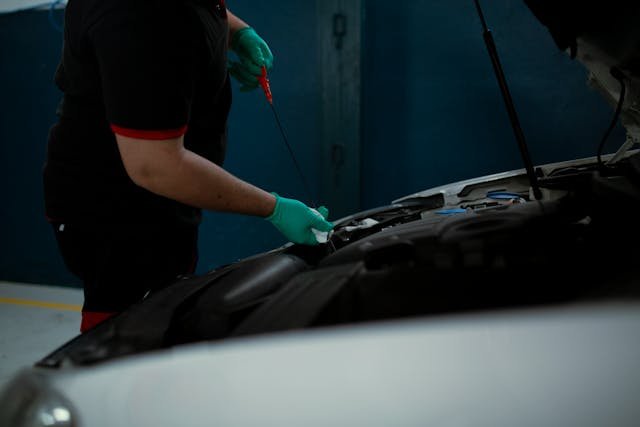
Most Calgary drivers follow the generic interval they read online. You know the one — change your transmission fluid every 60,000 to 80,000 kilometers. Here’s the problem: that number was built for mild-climate, highway-driving conditions. It was not built for Deerfoot at minus 27, Chinook temperature swings of 25 degrees in 24 hours, or stop-and-go school-zone crawls in January.
This guide gives you the Calgary-specific answer. You’ll learn exactly how often to change your transmission fluid given your actual driving conditions, the seven warning signs that your fluid is already overdue, and what a fair price looks like at a local shop. Everything here is drawn from our AMVIC-certified technicians’ experience servicing vehicles on Calgary roads — updated January 2026.
What Transmission Fluid Does — and Why It Degrades Faster Than You Think
| QUICK ANSWER In addition to providing the hydraulic pressure necessary for automatic gear shifts, transmission fluid lubricates gears and cools the transmission housing. The fluid loses viscosity and friction modifiers as heat-driven oxidation progresses. Degradation occurs more quickly than standard maintenance schedules predict in Calgary’s climate due to cold starts that stress the fluid before it warms up. |
Your transmission fluid is doing three jobs at once — and most guides only mention one.
Yes, it lubricates. But it also cools — the transmission generates significant heat under load, and the fluid carries that heat away from critical components. And in an automatic, it provides the hydraulic pressure that physically moves your gears. Remove any one of those three functions, and your transmission starts failing.
What most general maintenance guides fail to account for is this: heat is the primary killer of transmission fluid, not mileage. Every time your fluid reaches operating temperature, oxidation begins. Friction modifiers — the additives that protect clutch packs and bands — deplete with every heat cycle. Once they’re gone, metal starts meeting metal.
As of January 2026, our Mighty Auto Repairs technicians regularly pull transmission fluid samples that show severe oxidation on vehicles well under the standard 60,000-kilometer mark. The culprit, in most cases: cold starts. Cold ATF can reach up to three times its normal operating viscosity, forcing the transmission pump to work hardest when the fluid provides the least protection.
| Cold starts are harder on transmission fluid than any highway kilometer you’ll ever drive. |
Knowing how fluid degrades is useful. Knowing whether your driving conditions accelerate that degradation is what actually changes your maintenance decision — and that’s what the next section covers.
Calgary’s Climate Makes You a Severe-Duty Driver — Here’s Why That Changes Everything
Calgary drivers qualify as severe-duty users under most OEM maintenance definitions. Stop-and-go Deerfoot commutes, winter temperatures regularly below minus 25 Celsius, and Chinook cycle temperature swings of up to 30 degrees within 24 hours all stress ATF beyond normal operating parameters — reducing its effective service life by up to 50 percent compared to mild-climate benchmarks. |
Most Calgary drivers meet the OEM severe-duty threshold due to sub-zero cold starts, Chinook freeze-thaw cycles, and Deerfoot stop-and-go commutes — qualifying them for transmission fluid changes at 25,000 to 40,000 kilometers rather than the standard 60,000 to 80,000 kilometer interval. |
You probably think of yourself as a normal driver. You’re not — at least not by the definition that determines your maintenance schedule.
Every major vehicle manufacturer defines two maintenance tiers: normal and severe-duty. Normal assumes mild temperatures, mostly highway driving, and trips over 16 kilometers. Severe-duty covers frequent cold starts, stop-and-go traffic, extreme heat or cold, and short trips. The fluid change intervals under these two categories differ by up to 50 percent.
Calgary checks the severe-duty box on at least three of four criteria for most residents:
| Severe-Duty Condition | Calgary Reality | Qualifies? |
| Temperatures below -18°C | Calgary averages 43 days per year below -20°C (Environment Canada, 2024) | Yes |
| Stop-and-go commuting | Deerfoot and Stoney Trail rank among Alberta’s most congested corridors | Yes |
| Short trips under 16 km | Most Calgary neighbourhood-to-school and neighbourhood-to-work commutes | Yes |
| Rapid temperature swings | Chinook events cause 20-30°C swings within 24 hours — repeated freeze-thaw stress on ATF. | Yes — unique to Calgary |
That last row is the one I think most Calgary drivers — and, frankly, most shop advisors outside this city — get completely wrong. Chinook cycles are not just weather inconveniences. Every freeze-thaw event is a cold-start event. Your ATF re-thickens overnight, and your transmission pump fights it again in the morning. Over a Calgary winter, that can mean 20 or more high-stress startups in a single season.
Under OEM severe-duty definitions — Toyota’s, GM’s, and Ford’s owner manuals all confirm this — the recommended fluid change interval drops from 60,000–80,000 km to 25,000–40,000 km for automatic transmissions.
Now that you know you’re a severe-duty driver, the next section gives you the exact interval table for your vehicle type — automatic, CVT, or manual.
How Often to Change Transmission Fluid in Calgary — The Right Interval by Vehicle Type
For Calgary drivers classified as severe-duty, automatic transmission fluid must be changed every 30,000 to 45,000 kilometers. CVT fluid intervals run slightly longer at 40,000 to 60,000 kilometers. Standard-condition intervals of 60,000 to 80,000 kilometers apply only to drivers with long-haul highway commutes and minimal cold starts — a profile that does not describe most Calgary residents. |
Calgary drivers should change automatic transmission fluid every 30,000 to 45,000 kilometers under severe-duty conditions; the generic 60,000 to 80,000 kilometer interval applies to mild-climate highway driving that most Calgary commuters do not perform. |
Here is the definitive interval—without qualification:. No, it depends on a follow-up answer.
How often to change transmission fluid in Calgary depends on your specific driving pattern and your vehicle type. Use the table below:
| Transmission Type | Calgary Severe-Duty Interval | Standard Interval (mild conditions) |
| Automatic (conventional) | 30,000–45,000 km | 60,000–80,000 km |
| CVT (continuously variable) | 40,000–60,000 km | 60,000–100,000 km |
| Manual | 50,000–80,000 km | 80,000–100,000 km |
| Dual-clutch (DCT) | 40,000–60,000 km | 60,000–80,000 km |
One important note on CVTs: their fluid is not interchangeable with conventional ATF — not even close. Using the wrong fluid in a CVT will destroy the variator belt within months. Always confirm the exact fluid specification with your technician before booking service. I’ve seen this mistake twice at our shop, both times at independent oil-change chains that weren’t CVT-specific. It cost those customers $3,000 each.
If your fluid is brown, black, or burnt-smelling, inspect immediately — regardless of mileage. Color and smell are more reliable real-world indicators than an odometer reading.
If your fluid hasn’t been checked but you’re noticing changes in how your vehicle shifts, the next section covers the seven symptoms that tell you the fluid is overdue.
7 Warning Signs Your Transmission Fluid Is Overdue — Especially in Winter
Signs that transmission fluid is overdue include dark or burnt-smelling fluid, delayed shifts when moving from Park to Drive, rough or slipping gear changes, a whining or grinding noise during shifting, and an overheating warning light. In Calgary winters, delayed engagement on cold starts is often the first symptom — and is commonly mistaken for normal warm-up behavior. |
The most common signs of overdue transmission fluid are dark or burnt fluid, rough gear shifts, delayed engagement, whining during gear changes, and transmission overheating — all of which worsen under Calgary cold-start conditions. |
If your transmission is trying to tell you something, here’s what it sounds like.
- Dark brown or black fluid indicates degradation, while healthy ATF appears red or light pink. Dark brown means oxidation. Black means it’s been burnt. Check yours on the dipstick — bring a white cloth for an accurate color read.
- Burning smell. A burnt smell from under the hood, or from the fluid itself, indicates the fluid has been overheating. This is not a ‘wait and see’ situation.
- Delayed engagement from Park to Drive. If your car takes more than one second to engage Drive after shifting — especially on a cold morning — your fluid is likely too degraded to build hydraulic pressure quickly. Most Calgary drivers assume this is just the car warming up. It isn’t.
- Rough, jerky, or slipping shifts. Smooth ATF creates smooth gear transitions. Degraded fluid causes the transmission to hunt for gears, slip between them, or clunk into place.
- Whining or grinding during gear changes. This indicates the pump is struggling — either the fluid is too thick (cold and degraded) or too thin (oxidized and depleted).
- Transmission overheating warning light. On modern vehicles, a transmission temperature warning is a direct sensor reading — not a general alert. Take it seriously immediately.
- Fluid level is low with no visible external leak. Transmission systems are sealed. If you’re losing fluid without an external drip, you have an internal seal issue that needs diagnosis before a fluid change.
Key Takeaway: Delayed cold-start engagement is the most commonly missed early warning sign for Calgary drivers — do not dismiss it as a winter warm-up quirk.
Once you’ve identified a symptom — or confirmed your mileage puts you close to the service window — the next question most people ask is whether they need a flush or just a fluid change. The answer matters more than most shops will tell you.
| Noticing any of these symptoms?Book a free transmission fluid inspection at Mighty Auto Repairs — no charge, no obligation. Same-week appointments available. |
Transmission Flush vs. Drain-and-Fill: Which One Does Your Vehicle Actually Need?
| A drain-and-fill replaces 40 to 60 percent of transmission fluid and is appropriate for regular maintenance. A full flush exchanges nearly all fluid and is warranted when fluid is severely degraded. For most Calgary drivers, maintaining a consistent service schedule, a drain-and-fill is the right choice — and is less likely to disturb deposits in older, high-mileage transmissions. |
This is the question where most people get upsold. Let me give you a straight answer.
| Drain-and-Fill | Full Flush | |
| Fluid replaced | 40–60% | Approx. 95–100% |
| Method | Gravity drain + refill | Machine-assisted exchange |
| Best for | Regular maintenance intervals | Severely degraded fluid or OEM spec |
| Cost (Calgary) | $120–$200 | $200–$350 |
| Risk on high-mileage vehicles | Very low | Low to moderate — see note below |
| Recommended for most Calgary drivers? | Yes | Only when specifically indicated |
The moderate risk note on flushes for high-mileage vehicles is something most shops won’t mention — because it’s a reason not to upsell you. Here’s the honest version: on a vehicle that has gone well past its service interval, degraded fluid and metal particles can form a loose sludge that actually helps worn seals function by filling gaps. A machine flush removes everything — including that temporary buffer. In some cases, this causes leaks or shift problems to appear within days of the flush. Not common. But real.
Our approach at Mighty Auto Repairs: we inspect your fluid condition and mileage history before recommending a flush. If you’re within 10,000 km of your last service, a drain-and-fill is almost always the right call. If your fluid is severely degraded and you’re past 150,000 km on original fluid — that’s a conversation, not a default recommendation.
Key Takeaway: Ask your shop to inspect the fluid before booking a flush — and if they recommend one without looking, push back.
Now that you know which service you need, the last practical question is cost. The next section breaks down what a transmission fluid service should realistically cost in Calgary — and what you’re actually paying for.
What a Transmission Fluid Change Costs in Calgary — and What Honest Pricing Looks Like
A transmission fluid drain-and-fill in Calgary typically costs $120 to $200, while a full flush runs $200 to $350, depending on vehicle type and fluid specification. The service should include a pan inspection, a gasket and filter check, and a post-service road test. Compared to a transmission rebuild at $2,500 to $5,000, regular fluid changes are the lowest-cost protection available to Calgary drivers. |
Transmission fluid changes in Calgary cost $120 to $200 for a drain-and-fill and $200 to $350 for a full flush, depending on vehicle type and ATF specification — compared to $2,500 to $5,000 for a transmission rebuild. |
Price transparency is rare in this service category. Here is what the numbers actually look like.
| Service | Calgary Price Range | What Should Be Included |
| Drain-and-Fill (conventional ATF) | $120–$180 | Drain, pan inspection, gasket check, refill, road test |
| Drain-and-Fill (synthetic ATF) | $160–$220 | Same as above — synthetic fluid carries a $30–$50 premium |
| CVT Fluid Service | $180–$260 | CVT-specific fluid — confirm specification before booking |
| Full Flush (conventional) | $200–$300 | Machine exchange, filter service, road test |
| Full Flush (synthetic) | $260–$350 | Same as above with synthetic specification |
The specific detail most quotes leave out: pan inspection and filter service should be included in any comprehensive transmission fluid change — not billed as an add-on. Your pan gasket is inspected for sealing integrity, and if your transmission has a serviceable filter (many modern units do not), it should be examined and replaced if plugged. At Mighty Auto Repairs, these are included in our standard service at no additional charge.
Frame the cost against the alternative. A transmission rebuild in Calgary runs $2,500 to $5,000, depending on the vehicle and the shop. A replacement — new or remanufactured — runs $3,500 to $7,000 installed. A $160 drain-and-fill every 35,000 kilometers is, without question, the best transmission insurance a Calgary driver can buy.
Key Takeaway: Any Calgary shop quoting under $120 or over $400 for a standard drain-and-fill warrants a second opinion — ask what’s included line by line.
The Calgary-Specific Answer — and Why It’s Different From What You’ve Read Online
Here’s the version of this advice that doesn’t get published enough: the 60,000 to 80,000-kilometer interval was not built for you. It was built for a driver in a mild climate, commuting on open highways, with no Chinook cycles and no minus-30 cold starts. That driver does not live in Calgary.
You are a severe-duty driver if you drive through at least one Calgary winter each year, commute on Deerfoot, and park outside. This implies that your CVT fluid should be changed every 40,000 to 60,000 kilometers, your automatic transmission fluid every 30,000 to 45,000 kilometers, and your fluid condition should be checked every year regardless of mileage.
The good news: the service is fast, it’s straightforward, and it costs a fraction of what a neglected transmission will eventually demand. Our AMVIC-certified technicians at Mighty Auto Repairs have been doing this inspection as part of every full-service visit for years — because we’d rather catch a fluid issue at 35,000 km than a transmission failure at 90,000.
| Book Your Transmission Fluid Inspection in CalgaryAMVIC-Certified Technicians — Same-Week Appointments — Honest, Transparent Pricing |
Call us directly or book online at mightyautorepairs.ca. No upsell. No surprises. Just a straight answer about what your transmission actually needs.
Frequently Asked Questions — Calgary Transmission Fluid
Q: How do I know if my transmission fluid is bad?
Check color, smell, and texture directly on the dipstick with a white cloth. Healthy ATF is red or light pink. Brown indicates oxidation. Black or burnt-smelling fluid means the friction modifiers are gone — change it immediately. Gritty texture means metal contamination, which requires a diagnostic inspection, not just a fluid change.
Q: What happens if you never change transmission fluid?
Degraded fluid loses viscosity and depletes friction modifiers, causing rough shifting, overheating, internal clutch pack wear, and — eventually — transmission failure. In Calgary’s severe-duty conditions, this progression happens faster than the standard interval suggests. A $160 fluid change every 35,000 kilometers is the cheapest insurance against a $3,500 rebuild.
Q: Is a transmission flush better than a fluid change?
d change cost in Calgary?
For most cars, a drain-and-fill costs between $120 and $200; for CVTs or cars that need synthetic ATF, the cost is between $160 and $260. $200 to $350 is the full flush. A pan inspection, a gasket check, and a post-service road test should all be part of the service. Before making a reservation, make sure everything is included; not all stores are the same.
Q: Can cold weather damage my transmission?
Yes. The transmission pump must circulate high-viscosity fluid before it reaches operating temperature due to cold starts, which puts the pump and seals under maximum strain at the worst possible time. This occurs frequently every season due to Calgary’s 25°C winters. This stress is greatly reduced by routine fluid changes using the appropriate cold-weather ATF viscosity rating.